So, you're looking at a 300-page manuscript and wondering, "How many hours of my life is this going to take?"
Whether you're an author bringing your own book to life, a new voice actor setting up your first home booth, or an indie publisher budgeting for a release, you need a straight answer.
The short answer? For every one hour of audio your listeners hear, expect to spend 4 to 6 hours of actual work.
That sounds like a lot, doesn't it?
But recording the audio is only one piece of the puzzle. When you factor in all the preparation, the re-recording of mistakes, the meticulous editing, and the final mastering, those hours add up fast.
In this guide, we'll break down exactly where the time goes, the difference between recording at home versus a pro studio, and what actually makes the 6:1 ratio so famous in the industry.
The Golden Rule: PFH and the 6:1 Ratio
Before we dive into timelines, you need to understand the most important acronym in audiobook production.
That acronym is PFH, which stands for Per Finished Hour.
A "Finished Hour" is exactly 60 minutes of the flawless, polished audio that you would buy on Audible.
It has no mistakes, no long awkward pauses, and no throat clearing.
Every single metric in the audiobook industry—from how long a project takes, to how much a narrator gets paid—is based on the PFH.
The 4:1 Recording Ratio
If you talk to working voice actors, you'll hear them mention the 4:1 ratio.
This means it takes about four hours of real-time work in the booth to produce one finished hour of audio.
Why does one hour take four to create? Because you aren't just reading.
When you're narrating a book, especially if you're engineering the session yourself, you are constantly stopping.
You stumble over a word, you stop the recording, you back up the track, and you re-read the sentence (a technique called "punch-and-roll").
You also have to take breaks to drink water, rest your vocal cords, or wait for an airplane to fly over your house.
The 6:1 Total Production Rule
While 4:1 covers your time talking into the microphone, it doesn't cover everything else.
When you zoom out and look at the entire project from start to finish, the industry relies on the 6:1 Production Rule.
This rule means that for every finished hour of audio, it takes a grand total of six hours of labor.
This includes prepping the manuscript before you even start, recording the audio, editing out all those clicks and breaths, checking the audio for errors, and finally mastering it to meet strict volume standards.
This is why a standard 10-hour audiobook (about a 90,000-word novel) will easily take 60 total hours of professional work.
Studio Recording vs. Home Studio Setups
Where you choose to record has a massive impact on your timeline. The industry is split between commercial recording studios and DIY home booths. Let's compare the two.
Working in a Professional Studio
When you rent time in a commercial studio, you're paying for speed and efficiency.
A pro studio is completely soundproofed. You will never have to pause your recording because an ambulance drove by or your neighbor started mowing the lawn.
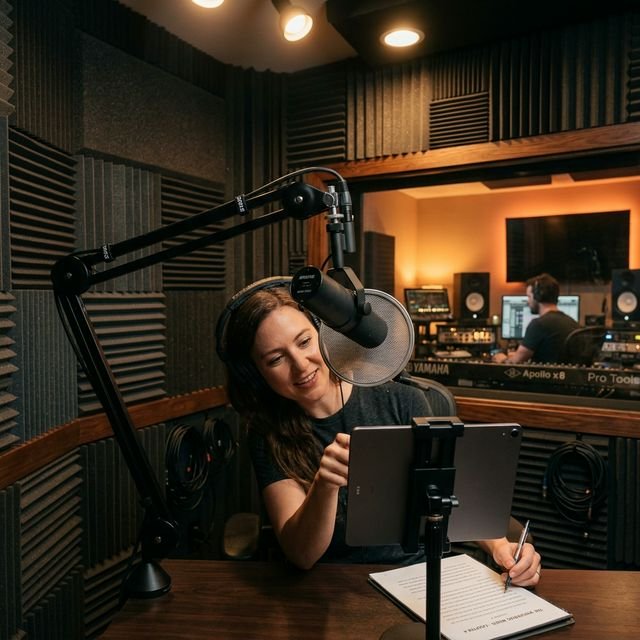
More importantly, in a pro studio, the narrator has an engineer sitting on the other side of the glass. The narrator just reads.
If they make a mistake, the engineer handles the technology—stopping the track, rolling it back, and matching the punch-in perfectly.
Because the narrator doesn't have to touch a mouse or keyboard, they can often crush the 4:1 ratio down to a highly efficient 1.5:1 or 2:1 ratio in the booth.
Navigating the Home Studio
Thanks to platforms like Audible's ACX (Audiobook Creation Exchange), the home studio has become the standard for independent narrators.
It saves thousands in studio rental fees, but it costs you time.
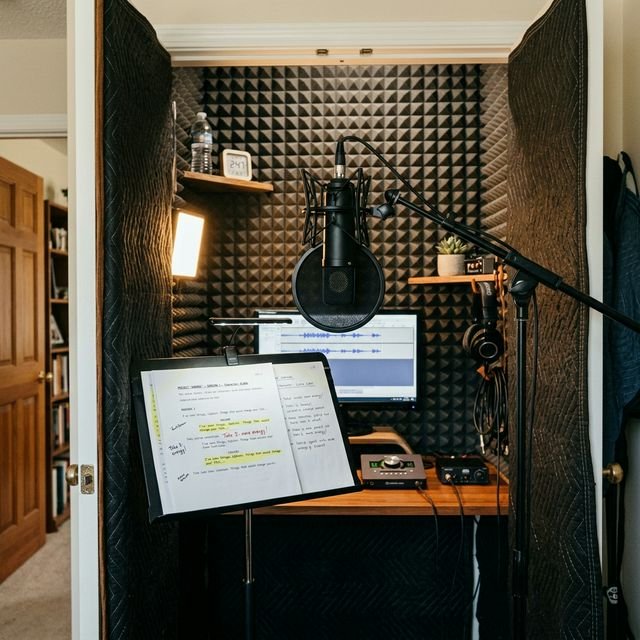
In a home studio, you wear every hat. You are the talent, the engineer, and the director.
Switching your brain between "performing character voices" and "checking audio waveforms on a screen" naturally slows down your pace.
Your home booth is also more vulnerable to random noises.
It's totally normal for indie narrators to lose 20% of their workday just waiting for the house to be completely silent.
In this environment, hitting a 4:1 ratio is a good day; for a beginner, a 6:1 ratio just for the recording phase is very common.
Where Do the Hours Actually Go?
Let's break down exactly how those six hours of labor are spent for every single Per Finished Hour (PFH).
- Pre-Reading and Prep (0.5 to 1 Hour): You can't just cold-read a book. You have to read the manuscript first to figure out the plot, define character accents, and look up tricky pronunciations. If you skip this, you might discover halfway through the book that a character you gave a gruff voice to is actually a teenager.
- Recording (1.5 to 2.5 Hours): This is your time in the booth. To prevent vocal damage, actors take frequent breaks. Interestingly, the labor union SAG-AFTRA recommends that voice actors shouldn't record for more than 4 to 6 hours a day due to vocal fatigue.
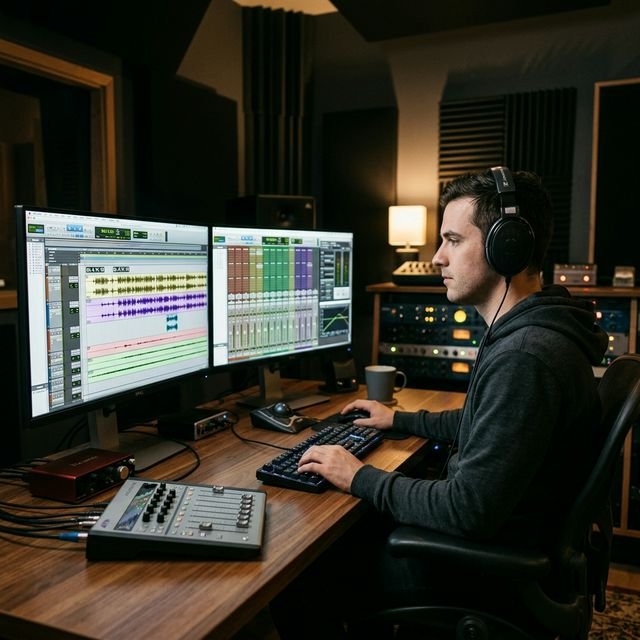
- Editing (2 to 3 Hours): This is the biggest time sink. The editor has to listen to the raw audio in real-time, removing loud breaths, mouth clicks, and background hums. They also have to adjust the pacing, ensuring the silent pauses between paragraphs and chapters feel natural.
- Proofing & Mastering (1 Hour): A proofreader (or "QC") listens to the edited audio while reading the script to catch any skipped words. Finally, the audio is equalized and compressed to meet strict distributor rules. For example, ACX technically requires files to measure between -23dB and -18dB RMS, with peaks no higher than -3dB.
What Slows Narrators Down?
Not every book takes the same amount of time.
Two major factors will speed you up or grind you to a halt.
1. The Genre of the Book
A breezy, modern self-help book is incredibly fast to narrate. You are just speaking in your normal, conversational voice.
An epic sci-fi or fantasy novel, however, is a different story.
You will have to slow down to properly pronounce dozens of made-up alien names, or perform ten different distinct character voices within a single chapter.
2. Experience Level
A veteran narrator has serious "sight-reading" skills.
Their eyes read a sentence ahead of what their mouth is saying, allowing them to naturally inflect the emotion without stumbling.
Beginners stumble more, forcing more re-takes, and meaning much more editing later.
Conclusion
Looking at the 60+ hours of labor required to create a standard 10-hour audiobook gives you a profound respect for the artistry involved.
It is a grueling, meticulous process that takes incredible skill and patience to do right.
The good news? As a listener, how fast you get through that book is entirely up to you.
Once the painstaking production is finished, you can use our audiobook speed calculator to estimate exactly how long it will take you to finish listening to the final product based on your favorite playback speed!
Frequently Asked Questions
Can I record an audiobook without an audio engineer?
Yes. Platforms like ACX allow independent narrators to act as their own engineers. However, running a solo home studio means you must narrate, edit, and master the files yourself. This significantly increases your required time, usually pushing the timeline to a 6:1 ratio (six hours of work for every one hour of finished audio).
How many words are in a typical 10-hour audiobook?
A standard 10-hour audiobook usually contains roughly 90,000 to 95,000 words. Because professional voice actors speak at a carefully controlled, conversational speed of roughly 150 words per minute, you can accurately estimate the final length of any manuscript using a simple word count.
Do I need a professional soundproof booth to record an audiobook?
While a commercial studio is ideal, an acoustically treated home closet can work perfectly well. The most crucial factor is an extremely low "noise floor" without echoes or background hums. Distributors like Audible run automated systems that will brutally reject files with high background noise levels.