In an era dominated by relentless content production—infinite podcast feeds, massive online course libraries, and endless Netflix queues—the most valuable currency is no longer the content itself. It is the time required to consume it. Enter the phenomenon of variable playback speed.
What was once a hidden, niche accessibility feature buried deep in the settings models of dedicated, downloadable software like VLC Media Player has now ascended to become a foundational pillar of modern media consumption. Over the last decade, altering how fast video and audio run has become a cultural mainstay, deeply embedded within the interfaces of YouTube, Spotify, Audible, and TikTok.
But what exactly is playback speed? How does the technology function under the hood to prevent voices from becoming high-pitched and completely unintelligible? And more importantly, what actually happens inside the human brain when the visual and auditory data intake stream is suddenly doubled? This comprehensive 1500-word guide breaks down the science, the software, and the strategies behind watching faster.
The Core Definition: What Is Playback Speed?
By strictly definitional terms, playback speed (also referred to occasionally as play rate or watch speed) is a user-adjustable feature integrated into digital media players that explicitly alters the temporal rate—the speed over time—at which a continuous media file is rendered and delivered to the user.
When a user interacts with a video or audio file, the baseline speed is inherently set at 1.0x. This is "real-time," representing the precise, unadulterated velocity at which the media was originally captured by the microphones and cameras in the studio. A 60-minute file played at 1.0x will exact a toll of 60 chronological minutes to consume.
Adjusting this multiplier instructs the player engine to accelerate or decelerate the playback logic. A 1.5x playback speed dictates that the media will be processed and rendered at 150% of the baseline baseline, effectively allowing the consumer to process three seconds of content every two seconds. Conversely, selecting a 0.5x speed forces the system to run in slow motion, rendering at 50% velocity, an invaluable mechanism commonly used for language acquisition, dense tutorial following, and transcription efforts.
The Analog Problem: The Chipmunk Effect
In the analog era of cassette tapes and vinyl records, altering the playback speed was a purely mechanical endeavor. If you spun a vinyl record faster, the frequency of the sound waves was physically compressed. This compression intrinsically raised the pitch of the audio track, resulting in voices sounding comically high-pitched—universally referred to as the Chipmunk Effect. Speeding up content used to fundamentally sacrifice intelligibility.
The Technology: How Modern Pitch-Preservation Works
If analog speed manipulation resulted in Mickey Mouse voices, why does listening to a YouTube video at 2.0x speed today sound perfectly natural, albeit just incredibly fast? The answer lies in sophisticated computer science algorithms that execute in real-time within your web browser.
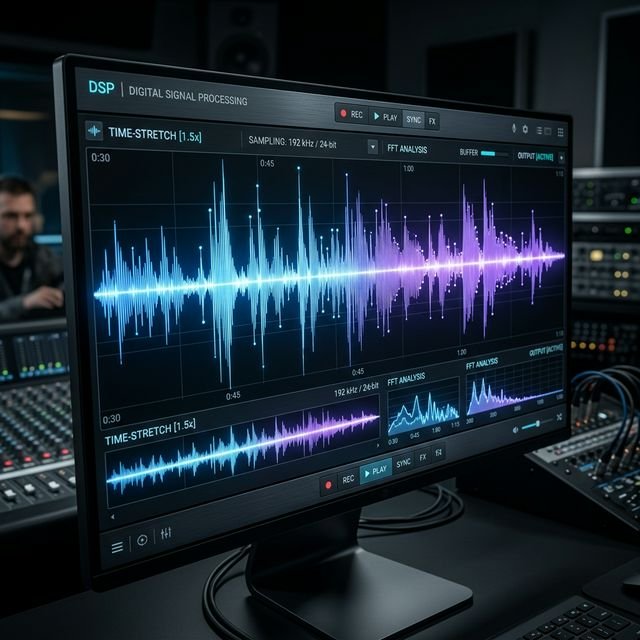
Modern video and audio players utilize a branch of Digital Signal Processing (DSP) known as Time-Stretching. When you hit the 1.5x or 2.0x button, an algorithm—most commonly a variation of WSOLA (Waveform Similarity Overlap-Add) or Phase Vocoding—is instantly deployed.
These algorithms are mathematically brilliant. Rather than just forcing the audio file to run faster, WSOLA breaks the continuous audio stream into microscopic, millisecond-long overlapping segments or "grains." The algorithm then strategically throws away some of these tiny audio segments while rapidly stitching the remaining ones back together. Because these cuts happen in fractions of a millisecond at exact waveform intersecting points, the human ear cannot detect the splices.
The resulting audio stream is physically shorter in duration, but because the actual frequency waveform inside the remaining grains was never compressed or stretched, the pitch—the deepness of the speaker's voice—remains 100% identical to the 1.0x original. This instantaneous, real-time math is the unsung hero that made the modern speed-listening revolution fundamentally possible.
Supported Speeds by Major Digital Platforms
Despite the universal adoption of time-stretching algorithms across web and mobile browsers, not all platforms restrict users identically. Depending on the medium—be it film, episodic television, user-generated tutorials, or long-form conversational podcasting—the allowable guardrails for speed multipliers vary drastically.
YouTube: The Pioneer of Custom Pacing
YouTube, as the world's preeminent educational and user-generated hub, natively supports a vast range from 0.25x up to 2.0x out of the box. Users can adjust pacing in exact 0.05x granular increments if using mouse shortcuts. For power users intent on surpassing the 2.0x ceiling to hit 3.0x or 4.0x, dozens of third-party Chromium browser extensions successfully unlock these upper echelons, making YouTube the most flexible platform on earth for speed-watching.
Netflix: The Hollywood Compromise
The introduction of variable playback speed to Netflix was one of the most highly contested technological shifts in the entertainment industry. When Netflix announced testing for the feature in 2019, highly prominent Hollywood directors and actors vehemently protested, arguing that altering the timing of cinematic delivery inherently damaged the artistic integrity, dramatic pauses, and comedic timing of their work.
As a compromise between consumer demand and artistic integrity, Netflix heavily restricted their native offerings. Currently, Netflix users are limited to a narrow spectrum ranging only from 0.5x to 1.5x.
Audiobooks (Audible) and Podcasts (Spotify)
Purely auditory mediums boast the highest speed allowances strictly because audio requires significantly less cognitive multitasking than absorbing both audio and visual data simultaneously.
Spotify caps its podcast and audiobook architecture at 3.0x. Meanwhile, Audible, Amazon's titan of the audiobook industry, pushes the absolute boundaries of digital time-stretching, allowing users to propel their narrators to a blistering 3.5x speed, a velocity utilized almost exclusively by highly trained power-readers and visually impaired users who rely heavily on screen readers at massive speeds.
The Science of Speed: Comprehension and Cognitive Load
A primary reason new users hesitate to adopt speed-listening is the ingrained assumption that watching a video faster directly correlates to a loss of comprehension. Will you miss crucial details? Will you fail to absorb the lesson? Cognitive science and neurological studies vigorously dispute this assumption.

The Cognitive "Goldilocks Effect"
The average conversational speaking rate—the speed at which a podcast host or YouTuber naturally talks into the microphone—is approximately 150 words per minute (WPM).
However, the human neurological system is engineered for significantly higher data thresholds. The average adult reads textual information at roughly 250 to 300 WPM. This discrepancy means that when you are sitting still and listening to a podcast at 1.0x (150 WPM), your brain is actively starving for data. There is an immense volume of excess cognitive bandwidth that your brain attempts to fill, leading inevitably to daydreaming, distraction, and a loss of focus.
"Speeding up content to 1.5x (roughly 225 WPM) creates the Goldilocks Effect for the human brain. The delivery of information now perfectly matches the listener's internal cognitive capacity—not too slow to induce boredom, and not too fast to induce panic."
When viewers increase the playback multiplier to 1.25x or 1.5x, they frequently report higher levels of retention and focus. The accelerated data stream forces the brain to pay strict attention, preventing the mind from wandering away from the content.
Neuroplasticity and Neural Adaptation
Attempting to watch a video at 2.0x speed on your very first try will almost certainly result in total cognitive failure; the voices will sound like an incomprehensible blur. However, the brain is deeply neuroplastic.
Studies involving neuroplasticity show that if a user incrementally increases the speed—starting at 1.1x for a few days, stepping up to 1.25x the next week, and slowly climbing to 1.5x—the brain will physiologically adapt to the new baseline. Audio processing centers in the brain grow more efficient at parsing the compressed phonetic streams. After several months of adaptation, users who regularly listen at 2.0x speed report that returning to 1.0x sounds paralyzingly, almost frustratingly slow, as if the speaker is artificially dragging out every syllable.
Proven Tips for Beginners to Start Speed-Watching
If you are looking to reclaim hundreds of hours of your life by incorporating playback multipliers into your daily routine, it is imperative to start methodically. Jumping straight into high speeds will only cause frustration.
- Start Slowly in the "Sweet Spot": Do not instantly jump to 1.5x. Begin your journey at precisely 1.15x or 1.25x. At this multiplier, the cadence of speech remains entirely conversational, yet you will passively save 12 to 15 minutes of time for every hour you watch.
- Choose the Right Genre: The content dictates the speed. Non-fiction audiobooks, daily news briefings, and long-form unedited interviews (like the Joe Rogan Experience or Huberman Lab) are prime targets for faster playback because they contain massive amounts of conversational "fluff."
- Protect High-Art and Comedy: Speed-watching is a tool for information extraction, not an absolute rule for all media. Do not speed up dramatic cinema, tension-heavy television sequences, or stand-up comedy specials. Comedy relies explicitly on the pregnant pause and comedic timing; accelerating it destroys the punchline.
- Discover Smart Speed (Silence Removal): If the concept of speeding up voices bothers you, look into podcast apps like Overcast or Pocket Casts that offer "Trim Silence" algorithms. These tools mathematically cut out dead air, long breaths, and pauses while leaving the actual voices at 1.0x, saving you 10% of your podcast time with zero auditory distortion.
Mastering playback speed is about intentionality. By utilizing multipliers smartly, calculating your finish times, and leveraging cognitive science, you can massively increase your educational intake without sacrificing a single ounce of comprehension.
Frequently Asked Questions (FAQ)
What is playback speed?
Playback speed is a feature in video and audio players that allows users to alter the temporal rate at which media is consumed. By adjusting the multiplier (e.g., 1.5x or 2.0x), users can watch or listen to content significantly faster than its recording in real-time.
Why doesn't the voice pitch go up when I speed up a video?
Modern media players use a digital signal processing (DSP) technique called time-stretching—specifically through algorithms like WSOLA or Phase Vocoding. These complex algorithms physically drop microscopic, millisecond segments of audio and splice the rest back together, effectively altering the speed of the audio stream without artificially altering its acoustic pitch, thus preventing the 'chipmunk effect'.
Is watching videos at 2x speed bad for your brain?
No, listening to audio or watching at 2x speed is not bad for your brain. Extensive neurological research confirms that the human brain can process spoken information significantly faster than humans naturally speak. In fact, many individuals report hyper-focus when speed watching, as the rapid data stream bridges the gap between conversational speaking speed and natural cognitive processing limits, preventing the mind from wandering.