Data-backed formulas and industry benchmarks. Fact-checked for accuracy.
When I first wanted to understand my team's productivity, I felt that there just had to be a simple way to do it. Labor productivity shows exactly this—how much of a result a worker or team produces from their effort.
In this article, I am going to explain to you in my own simple way how you can measure output using worker hours. And yes, I have also added a small calculator right here—so that you can immediately see your own productivity without doing any of the complicated math!
I have made this tool as simple and straightforward as possible. You only need two numbers from your business to get started:
Total Output: Just enter the total result your team produced. Depending on what you do, this could be your total revenue (like $10,000) or the number of items created (like 500 products) during a specific time frame.
Total Labor Hours: Next, enter the total number of hours your team worked to get that result. If you have 5 people who each worked 40 hours, that is 200 total labor hours.
Hit the Calculate Productivity button, and the tool will instantly show you exactly how much output you are getting for every single hour of hard work.
What Actually is Labor Productivity?
At its core, labor productivity is simply a way to measure the amount of value created by one hour of work. In the easiest terms: it tells you the exact return you are getting on the time your team invests.
According to the U.S. Bureau of Labor Statistics, labor productivity is one of the most important economic indicators, used to assess the efficiency of entire industries and individual businesses alike.
It is easy to confuse productivity with efficiency, but I like to separate them like this:
Efficiency is about the process—doing things without wasting time or resources.
Productivity is about the result—the actual, measurable output at the end of the day.
By keeping an eye on this simple number, you can finally see if your new strategies, tools, or schedule changes are actually helping your team get more done. And if you ever want to zoom in and look at how a single team member is doing rather than the whole group, I highly recommend checking out my employee productivity calculator. It is just as simple to use, but it is tailored specifically for tracking individual performance!
For teams that bill clients for their time, your employee utilization rate is another essential companion metric — it tells you what percentage of your team's available hours are actually generating revenue.
The Labor Productivity Formula
Honestly, I used to get overwhelmed by business formulas, but this one is incredibly straightforward. You do not need an accounting degree to figure it out.
The math happening behind the scenes in the calculator looks like this:
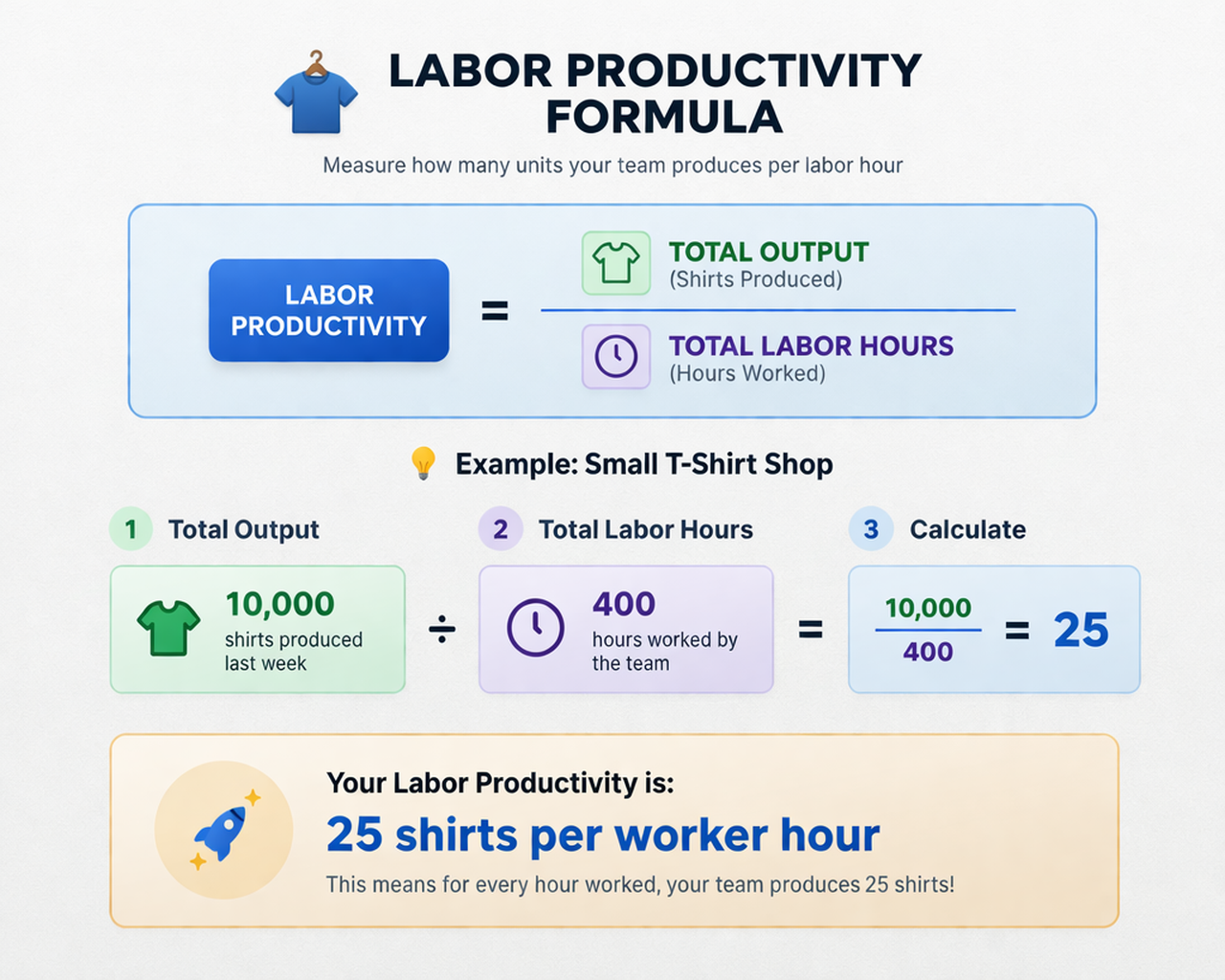
Labor Productivity = Total Output ÷ Total Labor Hours
Let's look at a quick example. Imagine you run a small custom t-shirt shop. Last week, your team produced 10,000 shirts (your Total Output). To get that done, your team worked a combined total of 400 hours (your Total Labor Hours).
If we divide 10,000 by 400, we get 25.
That means your labor productivity is 25 shirts per worker hour. Once I started seeing my business in these simple terms, it completely changed how I managed my time and my team.
💡 Expert Tip: Choose Your "Output" Metric CarefullyWhen selecting what counts as "output," stay consistent over time. If you measure revenue one month and units the next, your productivity trend becomes meaningless. For most service businesses, revenue generated is the best metric. For manufacturing and production, use units produced. What matters most is that you compare apples to apples, week over week.
The labor productivity formula: Total Output ÷ Total Labor Hours = Output per Worker Hour.
Why Knowing This Number Actually Matters
You might wonder "if everything's going smoothly, why should I even keep track of this?" Well, I learned the hard way that "fine" doesn't always mean profitable.
Here is why keeping an eye on your output per worker hour is a game-changer:
Spotting Hidden Roadblocks: If your productivity suddenly drops, it is a giant red flag. Maybe a software tool is broken, or a clumsy new process is actually slowing people down.
Smarter Pricing: If you know exactly how many hours it takes your team to deliver a service, you can price your offerings accurately without accidentally undercutting yourself.
Better Hiring Decisions: Instead of guessing when you need to hire, this number tells you exactly when your current team is truly maxed out.
Tracking Process Improvements: When you implement a new tool or workflow, measuring productivity before and after is the only way to verify it actually worked. Otherwise, you are just guessing.
💡 Expert Tip: Track Trends, Not SnapshotsA single week's productivity number can be misleading — maybe someone was sick, or a machine broke down. The real power of this metric comes from tracking it consistently over 4-8 weeks and watching the trend line. A consistent downward trend demands attention. A single bad week usually does not. If you want to dive deeper into tracking efficiency over time, our Productivity Efficiency Calculator breaks this down even further.
Labor Productivity Benchmarks by Industry
One of the most common questions I get is: "What is a normal labor productivity number?" The truth is, it depends entirely on your industry. A manufacturing plant and a consulting firm will have very different baselines.
Important: These ranges are meant to give you a general sense of direction only. Your specific numbers will depend on your business model, location, team size, and pricing. The most valuable comparison is always your own productivity this month vs. last month.
If you want to track the non-productive time that is eating into these numbers, our Non-Productive Time Calculator can help you identify exactly where those hours are going.
5 Proven Ways I Improve Labor Productivity
Once you know your number, the next step is making it go up! Here are a few practical things I focus on to boost output without burning people out:
Cut the Busywork: I am a big believer in automation. If a task is repetitive—like data entry, scheduling, or sending reminder emails—find a tool to do it. Let your team focus on the actual, high-value work.
Invest in Proper Training: It sounds obvious, but when I finally took the time to properly train my team, our output skyrocketed. People simply work faster when they are confident in what they are doing.
Upgrade Your Tools: You cannot build a house quickly with a broken hammer. Giving your workers the right software, fast computers, or proper equipment pays for itself in hours saved.
Set Clear, Realistic Goals: I noticed that when my team didn't know exactly what the target was, productivity drifted. Clear daily or weekly goals keep everyone pulling in the exact same direction.
Encourage Real Breaks: This one surprised me at first. Pushing people to work 10 hours straight actually hurts output. Short, regular breaks keep minds sharp and error rates low. Research consistently shows that burnout is one of the biggest silent killers of long-term productivity.
Conclusion
Understanding and tracking your labor productivity is one of the simplest, most impactful things you can do for your business. The formula is straightforward — Total Output ÷ Total Labor Hours — and the insights it reveals are genuinely powerful.
Whether you are running a manufacturing floor, a consulting agency, or a small e-commerce shop, knowing your output per worker hour helps you price correctly, hire at the right time, and spot problems before they become expensive.
Use the free calculator at the top of this page to find your baseline today. Then track it weekly or monthly and aim to improve by just 5% each period. Small, consistent gains compound into transformative results over time.
Frequently Asked Questions (FAQs)
Whenever I talk to people about measuring output, these same questions always come up. Here are the simple answers I have learned along the way.
What is a "good" labor productivity ratio?
Honestly, there is no magic number that applies to every single business. A "good" ratio for a software company is going to look completely different from a local bakery. What I always recommend is finding your own baseline first. Calculate your current productivity using the tool at the top of this page, and then just try to improve that specific number by 5% next month. You are competing against yourself, not everyone else.
How do you measure output for service-based businesses?
This used to trip me up, too! If you are not making physical products like t-shirts or widgets, measuring "output" feels a bit tricky. For service businesses, I like to measure output in terms of revenue generated, billable hours, or client projects completed. For example, if your agency generates $5,000 in a week and your team works a total of 100 hours, your productivity is $50 per worker hour. Keep it simple.
Does higher labor productivity always mean higher profits?
You would think so, right? But not always. If your team is churning out products faster than you can actually sell them, you are just building up expensive inventory sitting in a room. Or, if quality drops because everyone is rushing to hit a high number, refunds and unhappy customers will quickly eat up those profits. I always say: aim for sustainable productivity, where speed and high quality are perfectly balanced.
What is the difference between labor productivity and total factor productivity (TFP)?
Labor productivity only factors in worker hours as the input. Total Factor Productivity (TFP) goes further by accounting for all inputs — including capital, technology, and energy. TFP is used more at the macroeconomic level (think government statistics and economic research), while labor productivity is the practical, day-to-day metric most businesses use for workforce management. If you are interested in growth-level analysis, our Productivity Growth Rate Calculator covers TFP and Solow residual analysis.
How often should I measure labor productivity?
For most businesses, weekly or monthly tracking strikes the right balance. Weekly data helps you catch issues fast, while monthly averages smooth out natural fluctuations like holidays or one-off absences. Avoid daily tracking unless you are running a high-volume production line — daily numbers can be misleading due to equipment downtime or staff absences that are not representative of the norm.